Collected Home
Maximalist Home Organization: How to Make More Stuff Feel Intentional
You do not need to become a minimalist to make a collected home easier to live with. Use function, boundaries, curation and rotation to give the things you love more structure.
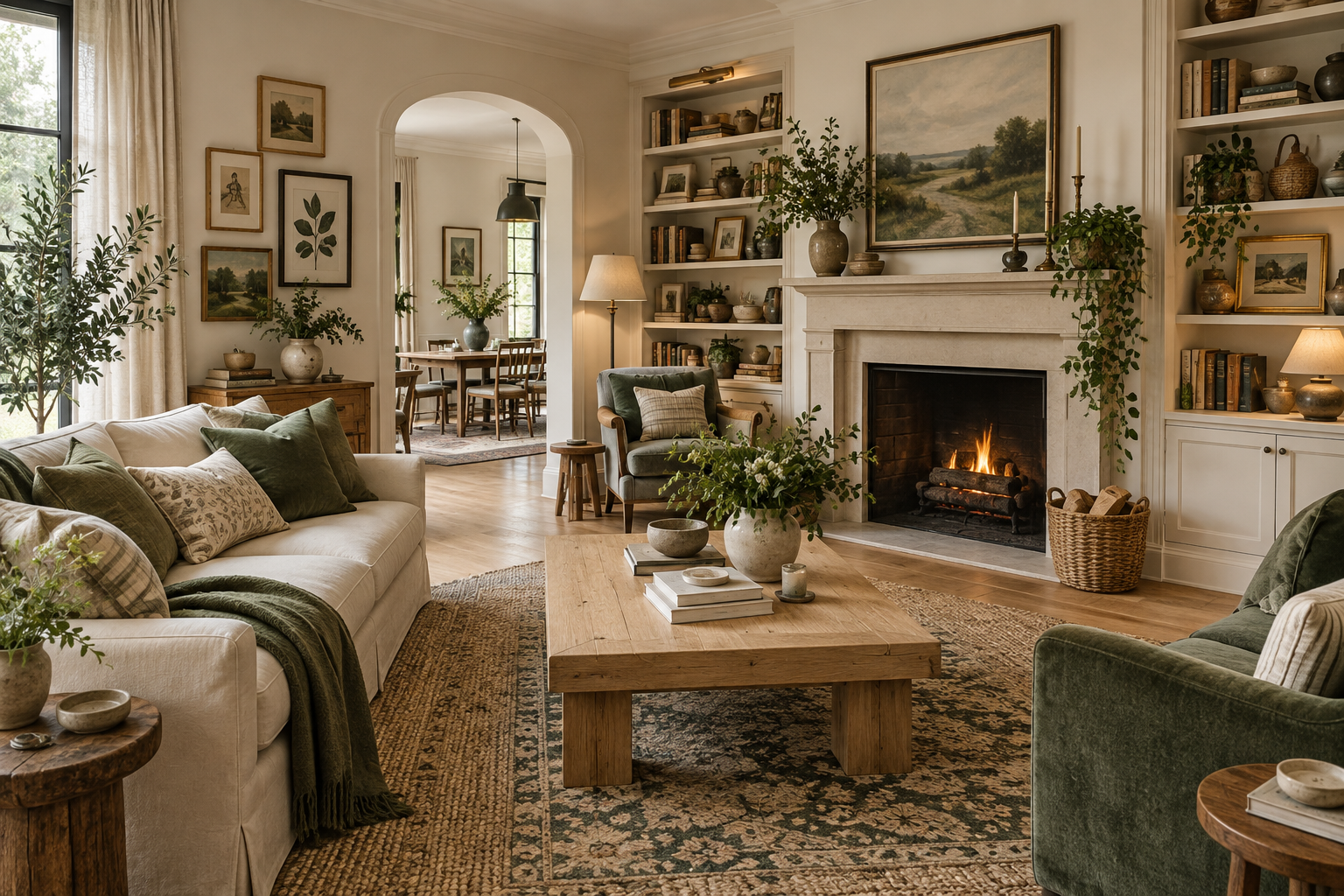
A maximalist home can contain a lot and still feel calm to live in.
The problem is not automatically the number of books, artworks, ceramics, records, photographs or meaningful objects you own.
The problem usually appears when the collection begins to interfere with the room itself.
A table stops being usable.
Favourite pieces disappear behind everything else.
New acquisitions have nowhere obvious to go.
Stored items become difficult to find.
The room still contains things you love, but the collection has lost its structure.
That is where maximalist home organization becomes more useful than simply asking what you should get rid of.
The goal is not to make the home sparse.
It is to make abundance easier to understand, use and enjoy.
Maximalism and clutter are not the same thing
A full room is not automatically a cluttered room.
A collection can be large and still feel intentional when:
- you know what belongs to it
- the pieces have a relationship to one another
- the collection has a clear territory
- you can find what you want
- you can return items without major effort
- favourite pieces are visible
- the room still works
- new pieces are added deliberately
Clutter behaves differently.
It tends to spread into unrelated spaces, block useful actions, bury favourite objects or make storage and maintenance harder than the enjoyment you get from the collection.
That distinction matters because it changes the first question.
Instead of:
How much should I get rid of?
ask:
How should this collection live in the room?
If you are unsure whether the real problem is quantity or structure, Collection or Clutter? How to Tell the Difference Without Becoming a Minimalist gives you a practical diagnostic.
Start with what the room still needs to let you do
Before moving a single collectible, decide what function the room must protect.
A living room may need to let you:
- sit comfortably
- use the coffee table
- reach shared storage
- move through the room easily
- watch television or listen to music
A dining room may need to let you:
- sit down for meals
- use the table
- open storage
- move chairs freely
A bedroom may need to let you:
- sleep
- dress
- reach the wardrobe
- move safely between the bed and door
The collection should support the room rather than quietly replacing its function.
This does not mean a table has to be empty.
It means you should know which part is display and which part must remain usable.
That one decision often creates more clarity than buying another organizer.
Use the Curated Maximalism Method
A useful order for organizing a collected home is:
Protect → Bound → Curate → Organize → Rotate → Review
The order matters.
Do not begin by buying storage.
Do not begin by pulling everything out.
Do not begin by asking what should leave.
Begin with the relationship between the collection and the room.
Protect
Protect the function of the space.
Decide what the room still needs to let you do.
Bound
Give the collection a physical territory.
Choose the shelf, wall, cabinet, tray, box, unit or room that belongs to that collection.
Curate
Choose what deserves the visible layer now.
Not every valued object needs to be displayed at the same time.
Organize
Give the supporting collection a logic you can understand and maintain.
Rotate
Bring different pieces forward over time instead of assuming the visible collection must hold everything.
Review
Only after the first five steps ask whether something genuinely no longer belongs.
This sequence prevents “organization” from becoming immediate decluttering.
Give every collection a physical boundary
A boundary answers a different question from a quantity limit.
Instead of:
How many should I own?
ask:
How much space am I happy to give this collection?
That space is your Space Budget.
Examples might include:
- one full bookcase
- three shelves
- one wall
- one display cabinet
- two archival boxes
- one drawer
- one console
- one dedicated room
The boundary can be generous.
The point is not restriction for its own sake.
The point is knowing where the collection belongs.
A boundary also helps with future acquisitions.
If the collection still fits comfortably inside the chosen territory, the system is working.
If it begins to spread beyond it, you have several options before assuming something must leave:
- rearrange
- rotate
- archive
- relocate
- review the boundary
- review individual pieces
The boundary gives you a decision point.
Curate what is visible instead of displaying everything
Maximalism does not require every valued object to be visible at once.
In fact, a collection can become harder to enjoy when every piece is competing for equal attention.
Choose what deserves the visible layer now.
Ask:
- Which pieces do I most want to see?
- Which objects tell the story of this collection?
- Which pieces work well together?
- Which item should the eye notice first?
- Which pieces can support rather than dominate?
- Where would a little visual rest make the display easier to read?
The goal is not emptiness.
It is hierarchy.
If this is the main issue in your home, use How to Display Collections Without Looking Cluttered for the full display-focused method.
Organize the supporting collection by how you actually look for things
Once the visible layer is clearer, turn to the rest.
A collection feels easier to manage when its grouping logic makes sense to you.
Possible organizing logics include:
- type — books with books, bowls with bowls, cameras with cameras
- subject — travel, botany, music, architecture, family history
- era — by decade or historical period
- creator — by artist, author, maker, label or designer
- colour — useful when visual impact matters more than retrieval
- material — glass, ceramic, wood, metal, paper
- size — useful for storage efficiency or visual rhythm
- use — everyday, occasional, reference, display-only
- story — grouped by trip, event, memory or personal meaning
The best logic is not the one that looks most impressive.
It is the one that helps you:
- find something
- return something
- understand what belongs together
- enjoy the collection
If you naturally look for records by artist, alphabetical artist order may work.
If you think about ceramics by maker, organize by maker.
If you remember souvenirs by trip, a story-based system may be more useful than sorting by material.
Choose for your real behaviour.
Use rotation when the collection is larger than the display
If you value more pieces than the visible space can comfortably hold, rotation gives the collection room to breathe without shrinking it.
Some pieces can be:
Display
Visible now.
Rotate
Valued and accessible, but not currently displayed.
Archive
Protected and stored for longer periods.
Release
No longer part of the collection you want to maintain.
Rotation and archive are real destinations.
They are not disguised “maybe get rid of it” categories.
This matters because collectors often need a legitimate way to keep something without displaying it continuously.
The article How to Rotate a Collection Instead of Displaying Everything at Once shows how to make that stored layer accessible enough to re-enter the room later.
Make tables and surfaces do more than one job clearly
Tables, mantels, dressers and consoles become confusing when display objects mix with temporary everyday items.
Separate the jobs.
A surface might have:
Display area
The part intentionally used for objects, art, books, photographs, plants or collections.
Function area
The part that must remain usable for writing, preparing food, placing a drink, getting dressed, opening mail or setting down keys.
Temporary landing
One small tray, basket or defined edge for things that regularly arrive “for now.”
A full surface can still look intentional when everything on it has a role.
What makes the surface feel chaotic is often not fullness itself.
It is the mix between deliberate display and unresolved temporary objects.
Leave room for the collection to evolve
Collections change.
You may add:
- a new book
- a record
- another piece from a favourite ceramicist
- a travel object
- an inherited item
- a new artwork
A good system has a way to absorb change.
When something new enters, ask:
- Where does it belong?
- Does it join the active display?
- Does another item rotate out?
- Does the Space Budget still work?
- Does the grouping logic still make sense?
The point is not to create a rigid display you never touch.
It is to keep the collection intentional as it grows.
Review only after the system exists
If the collection still feels difficult after protecting function, setting boundaries, curating the display, organizing the supporting layer and using rotation, then review individual pieces.
At that point, you have better information.
You may notice that:
- some objects no longer fit the collection's identity
- duplicates no longer add anything
- one category takes more maintenance than enjoyment
- a piece has become disconnected from the collection
- an acquisition no longer makes sense for the Space Budget
Then release can be a genuine collection decision rather than the default first step.
Try this on one collection
Do not reorganize every collection in your home today.
Choose one.
Then answer:
Function: What does the room still need to let me do?
Boundary: What physical territory belongs to this collection?
Visible layer: Which pieces deserve to be seen now?
Organization: What grouping logic helps me find and return things?
Rotation: What can stay accessible without being displayed?
Review: Is anything genuinely no longer part of the collection I want?
Make one useful change.
That is enough.
A collected home does not need to become emptier to become clearer.
It needs structure that lets the things you love belong somewhere on purpose.